Donald Trump again drives the political agenda with moves that blur governance, symbolism and provocation, while other institutions confront longer-running fights over war, climate and the boundaries of state power. The day also brings personnel decisions, cultural flashpoints an...
Donald Trump again drives the political agenda with moves that blur governance, symbolism and provocation, while other institutions confront longer-running fights over war, climate and the boundaries of state power. The day also brings personnel decisions, cultural flashpoints and a transatlantic display of diplomatic stagecraft.
Israel’s defence minister, Israel Katz, says Israel is prepared to remove Palestinians from Gaza and argues that any such plan depends on U.S. backing for where displaced people would go. He says Israel sees no solution for Gaza without what he calls migration and claims the government is ready to carry it out by sea, air or other means.
A new UN Environment Programme report says global temperatures are on course to exceed the Paris Agreement’s limits in the near term, while arguing that later emissions cuts could still bring warming back down. The report presents crossing the threshold as increasingly likely and frames rapid reductions in greenhouse gas emissions as the path to reversing the overshoot.
The U.S. Justice Department backs OpenAI in its copyright fight with The New York Times and other newspaper plaintiffs, filing a submission in federal court in Manhattan. The department argues that OpenAI’s use of news articles to train its AI systems is consistent with copyright law and should not be blocked by the court.
Trump says he is nominating acting Navy Secretary Hung Cao to hold the job permanently. Cao, a Navy veteran, has served in the acting role since April, and the move would formalize his leadership of the service at a time when Trump continues to shape senior national security appointments.
Trump says the Strait of Hormuz should be renamed the “Trump Strait,” casting the idea on social media as a way to make the strategic waterway “hotter than ever.” He links the suggestion to his claim that the passage is now under U.S. control, adding another provocative foreign policy message to his public feed.
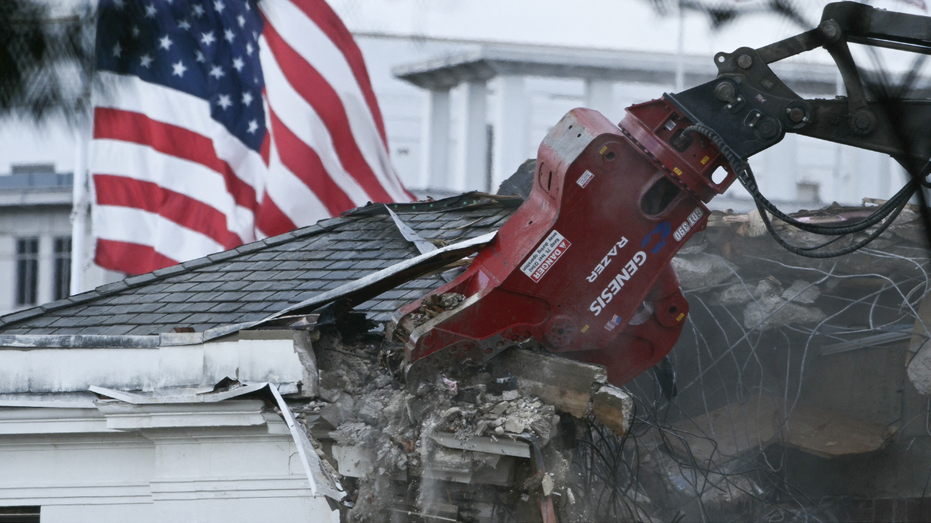
The Kennedy Center is removing “Blue,” a prominent outdoor sculpture that has long stood on the venue’s grounds. The roughly 24-foot aluminum installation, marked by a painted figure, is scheduled to come down Wednesday, making it the latest visible change at the institution during a broader Trump-era overhaul.
King Charles III and French President Emmanuel Macron meet at the British Museum to view the Bayeux Tapestry in London, joined by their spouses and senior British officials. The appearance is staged as a public affirmation of UK-France ties, using one of Europe’s best-known historical works to underscore the relationship.
Labour Mayor Andy Burnham uses his appearance during the prime minister’s first PMQs to argue that rising debt costs reflect the Conservatives’ record in office. His intervention brings fiscal credibility and borrowing costs into the chamber as the new government tries to define the economic inheritance it says it has received.


Top Politics stories
- Trump floats renaming Strait of Hormuz as “Trump Strait” amid US-Iran tensions (30 sources)
- Trump nominates acting Navy Secretary Hung Cao for permanent leadership role (21 sources)
- U.S. Justice Department backs OpenAI in New York Times copyright lawsuit (13 sources)
- King Charles and Macron view Bayeux Tapestry in London, praising UK-France ties (7 sources)
- UN report says global temperatures will soon exceed Paris targets and lays out a return path (7 sources)
- Israel defence minister says Gaza population removal would require US approval (7 sources)
- Kennedy Center removes outdoor sculpture “Blue” amid Trump-era overhaul (6 sources)
- DHS Secretary Markwayne Mullin’s plane makes emergency landing after engine failure (5 sources)
Drew Drafton
Author at IfHighLow